|
|
| (未显示2个用户的17个中间版本) |
| 第1行: |
第1行: |
| {{Infobox country
| | #REDIRECT [[埃森兰共和国]] |
| | name = Einsenland Republik
| |
| | native_name = Republik Einsenland
| |
| | motto = ''Einheit, Recht und Stärke'' <br/><small>(Unity, Justice and Strength)</small>
| |
| | anthem = ''Das Lied der Republik''
| |
| | capital = [[Eisenstadt]]
| |
| | largest_city = [[Eisenstadt]]
| |
| | official_languages = Einsen, German
| |
| | government = Federal parliamentary republic
| |
| | leader_title1 = President
| |
| | leader_name1 = Friedrich Hartmann
| |
| | leader_title2 = Chancellor
| |
| | leader_name2 = Katharina Weissberg
| |
| | area = 68,420 km²
| |
| | population = 14,830,000 (2025 est.)
| |
| | gdp = $612 billion (2025 est.)
| |
| | gdp_per_capita = $41,268
| |
| | currency = [[Einsenland Mark|Einsen Mark]] (EM)
| |
| | time_zone = UTC+1 (CET)
| |
| | drives_on = Right
| |
| | calling_code = +391
| |
| | internet_tld = .ei
| |
| }}
| |
| | |
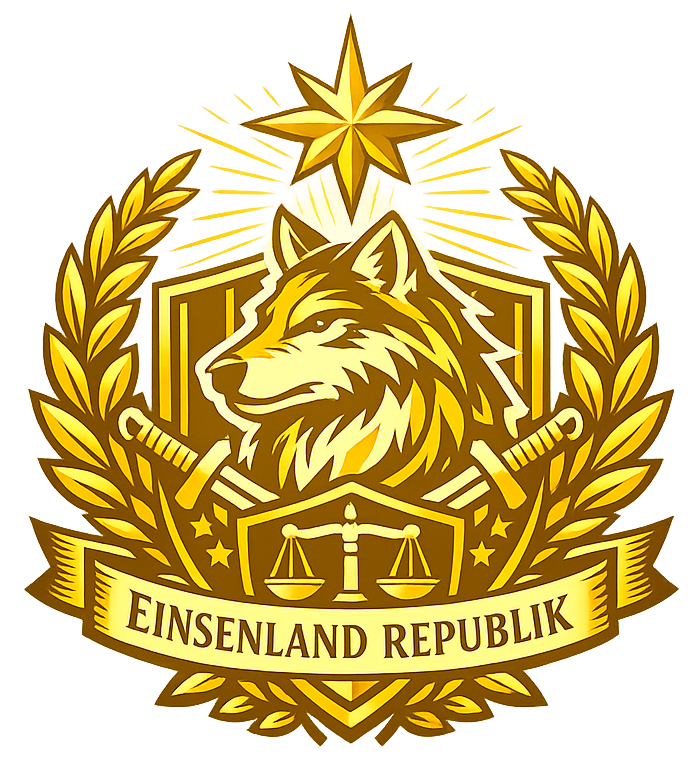
| The '''Einsenland Republik''' ({{lang|ei|Republik Einsenland}}), commonly known as '''Einsenland''', is a sovereign state and federal parliamentary republic in central-western Europe. It is bordered to the north by the North Sea, to the east by Germany, to the south by Switzerland and Austria, and to the west by France and Belgium. With a territory spanning '''68,420 km²''' and a population of approximately '''14.8 million''', Einsenland is a medium-sized European nation with significant economic and cultural influence.
| |
| | |
| The national capital and largest city is '''[[Eisenstadt]]''', which serves as the seat of government and is home to over 2.3 million residents. Other major cities include '''[[Stahlberg]]''', the nation's industrial heartland, and '''[[Westermoor]]''', the principal maritime port.
| |
| | |
| Einsenland is a '''[[Government of Einsenland|federal parliamentary republic]]''' operating under the '''[[Constitution of Einsenland|Grundordnung]]''' (Basic Order), the nation's constitutional framework established in 1923 and significantly amended in 1949 and 1991. The head of state is the '''President of the Republic''' (currently Friedrich Hartmann), while executive power is exercised by the '''Chancellor''' (currently Katharina Weissberg) and the Federal Cabinet.
| |
| | |
| == Etymology ==
| |
| The name "Einsenland" derives from the Old Einsen word ''Einsen'' (meaning "iron") combined with ''Land'' (territory or country). The name literally translates to "Iron Land" or "Land of Iron," reflecting the nation's deep-rooted connection to iron mining and metallurgy that has shaped its economy and identity since the medieval period. The iron-rich deposits along the '''Eisen River''' valley were the foundation upon which early Einsen settlements were built.
| |
| | |
| == History ==
| |
| {{main|History of Einsenland}}
| |
| | |
| === Early history and medieval period ===
| |
| The territory of modern Einsenland has been inhabited since the Neolithic period. Celtic tribes, particularly the ''Eisenii'', established settlements in the Eisen River valley around 500 BCE. The region came under Roman influence during the 1st century CE, when it formed part of the province of ''Germania Superior''. After the fall of the Western Roman Empire, Frankish and Germanic tribes settled the area.
| |
| | |
| During the medieval period, the region fragmented into several small principalities and free cities, collectively known as the '''Einsen Territories''' (''Einsenländer''). The discovery of extensive iron ore deposits in the 12th century led to a period of economic prosperity and the rise of powerful mining guilds.
| |
| | |
| === Unification and the First Republic (1848–1918) ===
| |
| The nationalist movements of the 19th century culminated in the '''Congress of Eisenstadt''' (1847–1848), which established the '''First Einsen Republic''' through the signing of the ''Vereinigungsakte'' (Act of Unification) on March 15, 1848. The new republic brought together the formerly independent principalities under a federal parliamentary system.
| |
| | |
| === The Interwar Period and Second Republic (1918–1945) ===
| |
| Following the disruptions of World War I, the republic underwent significant political reform. The '''Constitution of 1923''' (''Grundordnung'') established the framework for a modern democratic state with universal suffrage, separation of powers, and fundamental civil rights protections.
| |
| | |
| === Post-War Reconstruction and Modern Era ===
| |
| After World War II, Einsenland embarked on an ambitious program of reconstruction and modernization. The '''Economic Miracle''' (''Wirtschaftswunder'') of the 1950s and 1960s transformed the nation from a war-damaged economy into one of Europe's most productive industrial states. The constitutional amendments of 1991 further modernized the political system and strengthened individual rights protections.
| |
| | |
| == Geography ==
| |
| {{main|Geography of Einsenland}}
| |
| | |
| Einsenland occupies a diverse landscape in central-western Europe. The country can be divided into four main geographical regions:
| |
| | |
| * '''The Northern Lowlands''' — a flat coastal plain along the North Sea, characterized by marshlands, sandy beaches, and reclaimed polders
| |
| * '''The Central Plateau''' — rolling hills and fertile agricultural land forming the heartland of the nation
| |
| * '''The Eisen River Valley''' — the historic core of the country, running roughly north-south through the center
| |
| * '''The Southern Highlands''' — forested mountain ranges reaching elevations up to 2,840 m at Mount Eisspitze, the nation's highest point
| |
| | |
| The '''Eisen River''', the nation's longest waterway at 485 km, flows from the Southern Highlands to the North Sea and has historically served as the country's most important trade and transport route.
| |
| | |
| == Government and politics ==
| |
| {{main|Government of Einsenland}}
| |
| | |
| Einsenland is a '''federal parliamentary republic'''. The political system is defined by the [[Constitution of Einsenland|Grundordnung]], which establishes the separation of powers among the executive, legislative, and judicial branches.
| |
| | |
| * '''Head of State''': The '''President of the Republic''' (''Republikpräsident''), currently Friedrich Hartmann, serves a largely ceremonial role with important reserve powers
| |
| * '''Head of Government''': The '''Chancellor''' (''Kanzler''), currently Katharina Weissberg, leads the Federal Cabinet and directs domestic and foreign policy
| |
| * '''Legislature''': The bicameral '''[[Parliament of Einsenland|Bundesversammlung]]''' consists of the ''Volksrat'' (People's Council, lower house) and the ''Landesrat'' (State Council, upper house)
| |
| | |
| === Administrative divisions ===
| |
| {{main|Administrative divisions of Einsenland}}
| |
| | |
| Einsenland is divided into '''7 federal states''' (''Bundesländer''), each with its own state parliament and government. The states have significant autonomy in areas such as education, policing, and cultural affairs.
| |
| | |
| == Economy ==
| |
| {{main|Economy of Einsenland}}
| |
| | |
| Einsenland has a '''social market economy''' with a nominal GDP of approximately $612 billion (2025), ranking it among the wealthier European nations on a per-capita basis ($41,268). The economy is characterized by a strong industrial sector, particularly in steel production, precision engineering, automotive manufacturing, and chemical industries.
| |
| | |
| The national currency is the '''[[Einsenland Mark]]''' (EM), managed by the '''Einsenland National Bank''' (''Nationalbank'').
| |
| | |
| == Demographics ==
| |
| {{main|Demographics of Einsenland}}
| |
| | |
| As of 2025, Einsenland has a population of approximately '''14.83 million''' people. The country is moderately urbanized, with about 72% of the population living in urban areas. The official language is '''Einsen''' (a West Germanic language closely related to German), though standard German is also widely spoken and holds co-official status.
| |
| | |
| == Culture ==
| |
| {{main|Culture of Einsenland}}
| |
| | |
| Einsen culture reflects a blend of Germanic traditions with unique local customs shaped by the nation's industrial heritage and republican values. The country is known for its classical music tradition, architectural heritage, and a strong civic culture emphasizing public education and institutional trust.
| |
| | |
| == See also ==
| |
| * [[History of Einsenland]]
| |
| * [[Government of Einsenland]]
| |
| * [[Geography of Einsenland]]
| |
| * [[Economy of Einsenland]]
| |
| * [[Culture of Einsenland]]
| |
| | |
| {{Navbox Einsenland}}
| |
| | |
| [[Category:Einsenland]]
| |
| [[Category:Countries]]
| |